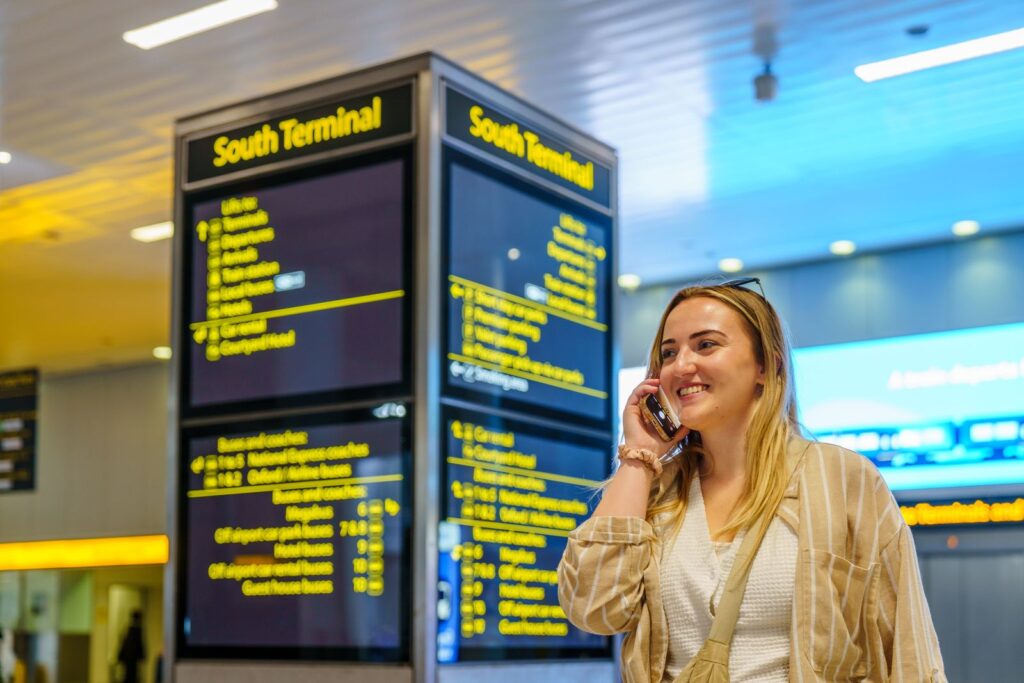
Every airport in the United States stopped sending planes into the air on Friday, November 13, when the FAA issued a nationwide ground stop over communication trouble at its en-route control centers. For travelers crossing the Atlantic, that raises the EU261 air traffic control question: when a government air traffic system fails, what does a European or British airline still owe you? The short answer is that cash compensation is unlikely, while meals, hotels, rerouting and refunds remain owed on covered flights.
Where it stands: Nobody in government had called off the stop as of roughly 5 p.m. ET Friday. The FAA advisory, issued at 3:54 p.m. ET, said departures should stay grounded “until further notice” and that “Inbound international flights will be managed on a case by case basis,” according to the advisory text published by Clash Report. The FAA’s statement described “communication issues impacting multiple Air Route Traffic Control Centers.” Neither the FAA nor Transportation Secretary Sean Duffy had given a root cause.
Travelling for Business, a UK trade outlet, warned that “transatlantic arrivals could be held, delayed or diverted, and return flights to London, Manchester and other UK airports cannot depart on schedule.” That second half matters most here: flights from New York, Chicago or Atlanta back to Europe sit on the ground while the stop lasts, and those are the flights where European rules may or may not reach you.
Which transatlantic flights EU261 and UK261 cover
Coverage depends on two things: where the flight departs and which airline operates it. Article 3 of Regulation 261/2004 applies to every passenger leaving an EU airport, with no carrier condition. Flights into the EU from outside are covered only “if the operating air carrier of the flight concerned is a Community carrier,” meaning an airline licensed in the EU. The UK kept the same structure after Brexit: the CAA says its version applies to all UK departures and to UK arrivals on UK or EU airlines.
| Your flight | Covered? |
|---|---|
| EU airport to the US, any airline | Yes, EU261 |
| US to the EU on an EU airline (Air France, Lufthansa, KLM) | Yes, EU261 |
| US to the EU on Delta, United or American | No |
| UK airport to the US, any airline | Yes, UK261 |
| US to the UK on British Airways or Virgin Atlantic | Yes, UK261 |
| US to the UK on a US airline | No |
So a traveler stuck at JFK on a Lufthansa flight to Frankfurt has EU rights, while the passenger at the next gate on a United flight to the same city does not. A United passenger flying Frankfurt to Newark the same night, however, is covered, because the trip began in the EU.
The EU261 air traffic control rule after the October court ruling
The regulation’s own preamble anticipated air traffic decisions. Recital 15 says extraordinary circumstances “should be deemed to exist” where an air traffic management decision on a particular day causes a long delay, an overnight delay or a cancellation, provided the airline took all reasonable measures. Article 5(3) then releases airlines from cash compensation when they can prove a cancellation came from extraordinary circumstances that “could not have been avoided even if all reasonable measures had been taken.”
On October 8 the EU Court of Justice narrowed how that works. In Case C-108/26 RX, it held that “not every air traffic management decision can, in itself, be classified as an ‘extraordinary circumstance’.” Its press release notes that airlines face such decisions “as a matter of course and on a regular basis.” The carrier now has to look behind the order: “It must demonstrate that that decision was taken on account of a circumstance which was itself of an extraordinary nature.” The court also said that where a delay has two causes, only the part caused by the extraordinary event is subtracted from the total when testing the compensation threshold.
Applied to Friday, the analysis runs as follows. The decision was the ground stop. The event behind it, as officials have described it so far, is a communications problem at the FAA’s own en-route centers, which no airline operates. That looks like the kind of outside event airlines can rely on. This is our reading of the ruling, not a court decision on November 13, and the cause has not been fully stated by officials. Delays that follow from an airline’s own choices later in the recovery, such as crew scheduling, could be argued separately.
Care is owed even when compensation is not
The more useful right for stranded passengers is care, and it survives extraordinary circumstances. In McDonagh v Ryanair, the volcanic ash case from 2013, the Court of Justice ruled that such events do not release airlines “from their obligation laid down in Articles 5(1)(b) and 9 of the regulation to provide care.” Article 9 lists what that means: “meals and refreshments in a reasonable relation to the waiting time,” a hotel when an overnight stay becomes necessary, “transport between the airport and place of accommodation,” and two free calls or emails.
For flights of more than 3,500 km, which includes every transatlantic route, care on a delay starts at four hours under Article 6. At five hours, you may abandon the trip and take a refund under Article 8. On a cancellation, Article 5 entitles you to the Article 8 choice between a refund and rerouting, plus care while you wait.
| Right | If caused by extraordinary circumstances |
|---|---|
| Meals and refreshments | Still owed |
| Hotel and transport to it | Still owed if overnight |
| Refund or rerouting on cancellation | Still owed |
| Refund on a 5-hour-plus delay | Still owed |
| Fixed cash compensation (up to €600) | Not owed |
The European Commission’s Your Europe page says that when an airline offers no assistance and you buy your own meals, it should pay you back as long as the spending was necessary, reasonable and appropriate, so receipts matter. The McDonagh ruling put the same limit on reimbursement: amounts that proved necessary, appropriate and reasonable.
What the UK CAA said after the NATS failure
The closest recent precedent is British. On September 8, a technical problem at NATS, the UK air traffic provider, disrupted hundreds of flights. The next day the Civil Aviation Authority issued guidance to airlines, the most recent example of a European regulator applying these rules to an air traffic system failure. It treated the outage as likely extraordinary, and went further, saying delays and cancellations “directly caused by the knock-on effects of the issue are also likely” to count as extraordinary circumstances.
It then spelled out what airlines still had to do. “Airlines must also look after passengers while they are delayed and provide them with meals, refreshments and hotel accommodation proportionate to the length of the delay.” Where they failed to, the regulator said “we expect airlines to promptly reimburse passengers for the reasonable costs they incur making their own arrangements.” The CAA added that its view was guidance only, and “Each case will be context and fact specific.”
The CAA statement also flagged the gap that matters for New York departures: “Different rights may apply to passengers arriving on flights to the UK operated by non-EU carriers such as flights from the USA on US carriers.”
The EU261 reform does not apply yet
The EU has agreed a rewrite of Regulation 261/2004, and the final text was signed in September 2026. It does not change anything for Friday’s disruption. The text says it “shall enter into force on the twentieth day following that of its publication in the Official Journal” and will apply 12 months after that. Flights disrupted by the November 13 ground stop are judged under the 2004 rules.
How to claim care and expenses
- Ask the airline first. At the airport, ask the operating airline’s staff for meal vouchers and a hotel if you are stuck overnight. The CAA says care is owed “regardless of the reason for the delay.”
- Keep itemized receipts. If the airline cannot arrange care, pay for reasonable meals, a standard hotel and transport, and claim the costs back. The CAA warns that airlines are unlikely to treat alcohol, luxury hotels or luxury meals as reasonable.
- Get the cause in writing. Ask for the stated reason for the delay or cancellation. It matters for any later compensation dispute and for card or travel insurance claims.
- Choose refund or rerouting deliberately. Taking a refund ends the airline’s duty to get you there. Rerouting keeps care running while you wait.
- Escalate if ignored. For UK261 claims, the CAA says you can escalate if the airline’s final answer is unsatisfactory or it takes more than eight weeks to reply. For US ticket refunds, see our guide on how to file an airline refund complaint with the DOT.
If you think a delay had a cause beyond the ground stop, such as a separate mechanical fault, a compensation claim is still open to you. The October ruling means the airline must identify the event behind any air traffic order, and on a transatlantic flight arriving more than four hours late, UK261 compensation is set at £520 per person when it is owed.
Frequently Asked Questions
Does EU261 apply to my flight from Paris to New York during the FAA ground stop?
Yes. EU261 covers every passenger departing an EU airport, whichever airline operates the flight, so a Paris to New York flight on Air France, Delta or United is in scope. Whether cash compensation is owed is a separate question that turns on extraordinary circumstances.
Is an FAA ground stop an extraordinary circumstance under EU261?
Probably, but not automatically. The EU Court of Justice ruled in October 2026 that an air traffic management decision is not, in itself, enough; the airline must show the event behind the decision was itself extraordinary. Officials have attributed this stop to communication problems at FAA control centers, which airlines do not run, but no court has ruled on it.
Do I get a hotel and meals if my flight to Europe is cancelled because of the ground stop?
If EU261 or UK261 covers your flight, yes. The EU Court of Justice held in McDonagh v Ryanair that extraordinary circumstances do not cancel the duty of care, and the UK CAA told airlines after the September NATS failure to provide meals, refreshments and hotels. If you pay yourself, keep receipts and claim reasonable costs back.
Does UK261 cover my flight home from New York on a US airline?
No. The UK rules cover all departures from the UK and arrivals into the UK on UK or EU carriers. A New York to London flight on a US carrier falls outside them, so its contract of carriage and US rules apply instead.
Has the new EU261 reform changed my rights for this disruption?
No. The amending regulation agreed in 2026 applies 12 months after it enters into force, so the original 2004 rules govern flights disrupted by the November 13 ground stop.
Sources
- FAA Nationwide Ground Stop Blamed on Air Traffic Control Comms Issue — Clash Report, November 13, 2026
- FAA ground stop halts US flights — Travelling for Business, November 13, 2026
- Regulation (EC) No 261/2004, Article 3: Scope (as adopted) — legislation.gov.uk (EU text as adopted), February 11, 2004
- Regulation (EC) No 261/2004, recitals (as adopted) — legislation.gov.uk (EU text as adopted), February 11, 2004
- Regulation (EC) No 261/2004, Article 5: Cancellation (as adopted) — legislation.gov.uk (EU text as adopted), February 11, 2004
- Regulation (EC) No 261/2004, Article 6: Delay (as adopted) — legislation.gov.uk (EU text as adopted), February 11, 2004
- Regulation (EC) No 261/2004, Article 9: Right to care — legislation.gov.uk, current text
- Press Release No 144/26: Judgment in Case C-108/26 RX, D (Air traffic management decision) — Court of Justice of the European Union, October 8, 2026
- CJEU – C 12/11 / Judgment: McDonagh v Ryanair Ltd — European Union Agency for Fundamental Rights (case-law summary), January 31, 2013
- Air passenger rights — Your Europe (European Union), current page
- CAA statement on passenger compensation following NATS disruption on 8 September — UK Civil Aviation Authority, September 9, 2026
- Delays — UK Civil Aviation Authority, current page
- Regulation amending Regulation (EC) No 261/2004 (PE-CONS 39/2/26 REV 2) — European Parliament and Council of the European Union, September 2026
This article is general travel and consumer information, not legal advice. Passenger rights depend on where your flight departs, which airline operates it and that airline’s contract of carriage; check your airline and the regulator named above. Recall Refunds reports what the sources listed above said on the dates shown, and facts in a developing story can change.